Nordvec
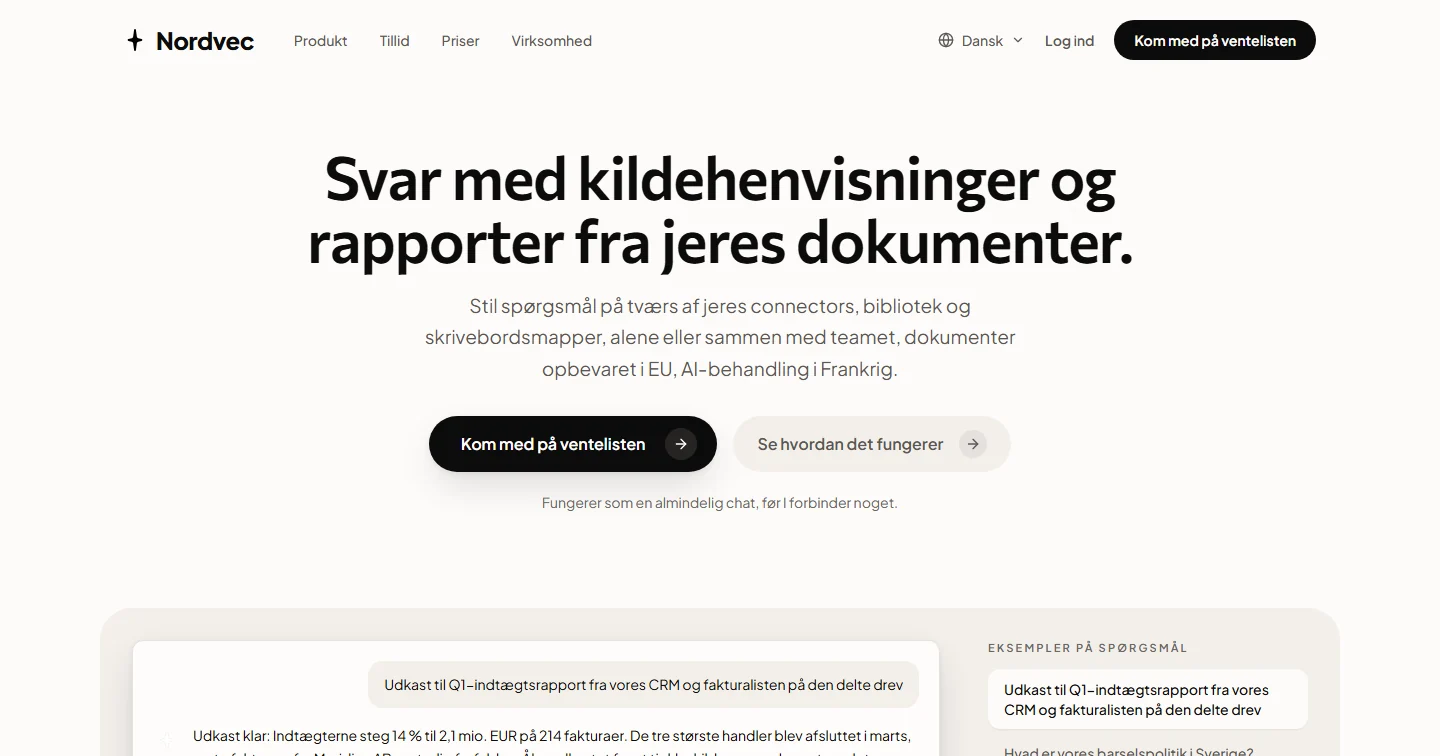
Nordvec is an AI assistant that answers with citations from a company's own tools and documents.
- Status
- In development
- Address
- nordvec.com
- Stack
- Next.js · TypeScript · Postgres + pgvector · Mistral
What Nordvec is
The assistant is built for European businesses and sole traders. It pulls in the content of the systems people already use and lets them ask in a plain chat, such as "what did we agree with the client in March?". The answer is written in full sentences and points to the documents it is based on.
Nordvec is built and runs, but has no customers yet: accounts open at launch.
The problem: shadow AI
In most companies, staff paste contracts, customer lists and accounting figures into ChatGPT because it is convenient. The data ends up with a US service the company has no data processing agreement with, although GDPR Article 28 requires one as soon as personal data is involved. Nobody knows what has been sent, and it cannot be taken back.
Nordvec is meant to be the alternative: just as easy to use, but the company owns it, can see what happens in it, and compliance can approve it. The idea is that individuals adopt it first and the company then buys it for everyone.
What Nordvec does today
Answers with citations
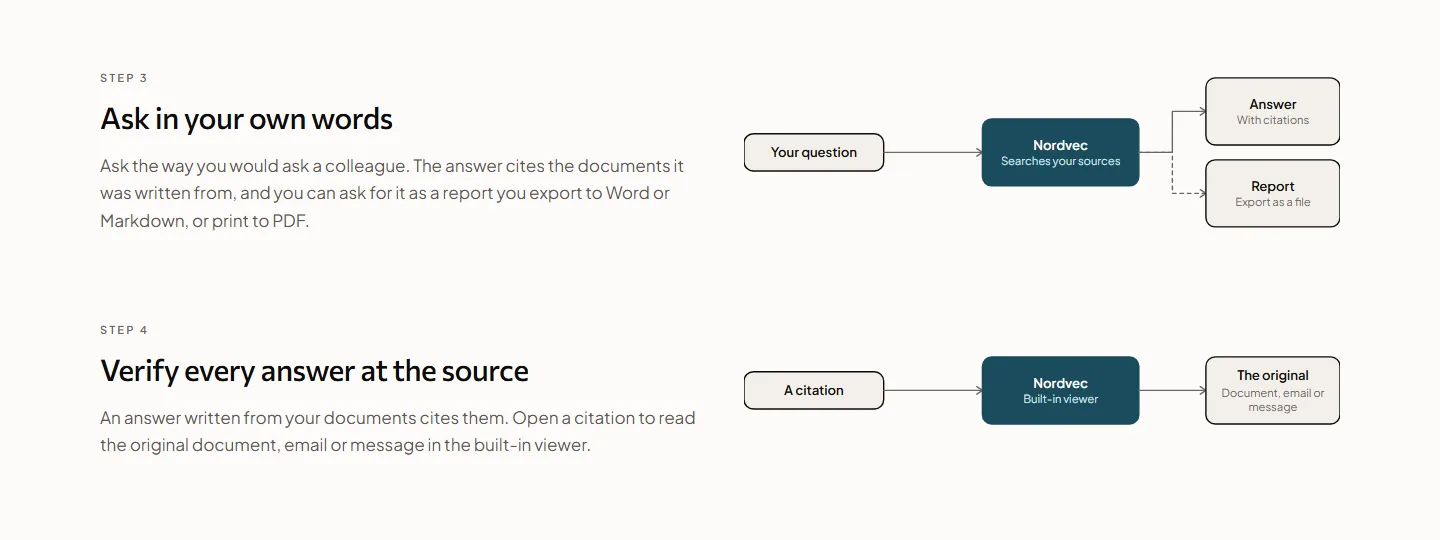
A citation opens the source in Nordvec's own viewer with the passage the answer used marked, whether that is a document, an email or a message. Search combines meaning with exact words, so it finds both "the deal with the carpenter" and a specific invoice number, across languages too.
Reports as files
Ask for a report, a memo or a help page and you get it as a file with its sources. It can be exported to Word or Markdown or printed to PDF, and versions can be compared. Mark a passage and ask the AI for a change, and you can accept or reject it.
Connections to your tools
Google Workspace, Microsoft 365, Dropbox, Box, Slack, Notion, Jira and HubSpot can be connected, and Nordvec keeps the content in sync. Nine more connections, including Confluence, Asana, Linear and GitHub, are built and waiting to be switched on. Only the person who sets up a connection can see what it fetches, and they can share one document at a time with a colleague, a group or the whole workspace. Google, Microsoft, Dropbox, Box and Jira read with that person's own account, while Slack, Notion and HubSpot read what the Nordvec app is given access to in the service.
Library and uploads
Upload PDF and Word files or paste text. Each document can be private, shared with a member or a group, or open to the whole workspace, and a file you have from several sources is stored once for you.
Folders from the desktop
A desktop application syncs folders from your own computer to the library.
Access, isolation and audit trail
The AI answers only from what you can access in Nordvec: your own material and what others have shared with you. Each company is isolated from the others down in the database. The audit trail of questions, document views and administrative actions can be exported and never stores the text of a question or an answer.
API and webhooks
An API lets the company's own people push documents in from older systems that have no integration. Webhooks report events with counts and timestamps, never with document content.
Compliance you can check
EU AI Act
The chat states that its answers are AI-generated, and exported reports are marked as AI-generated (Article 50). A public board shows each obligation's status and the evidence behind it.
GDPR as self-service
Users can export their data and correct their name from the settings themselves. They start deletion themselves too: the account is frozen at once, and after a 14-day waiting period in which they can cancel, everything is erased and an erasure receipt is issued. Under the terms, the AI advises and makes no binding decisions about a person, and Nordvec's agreement with Mistral rules out training on customer data.
Compliance library and trust page
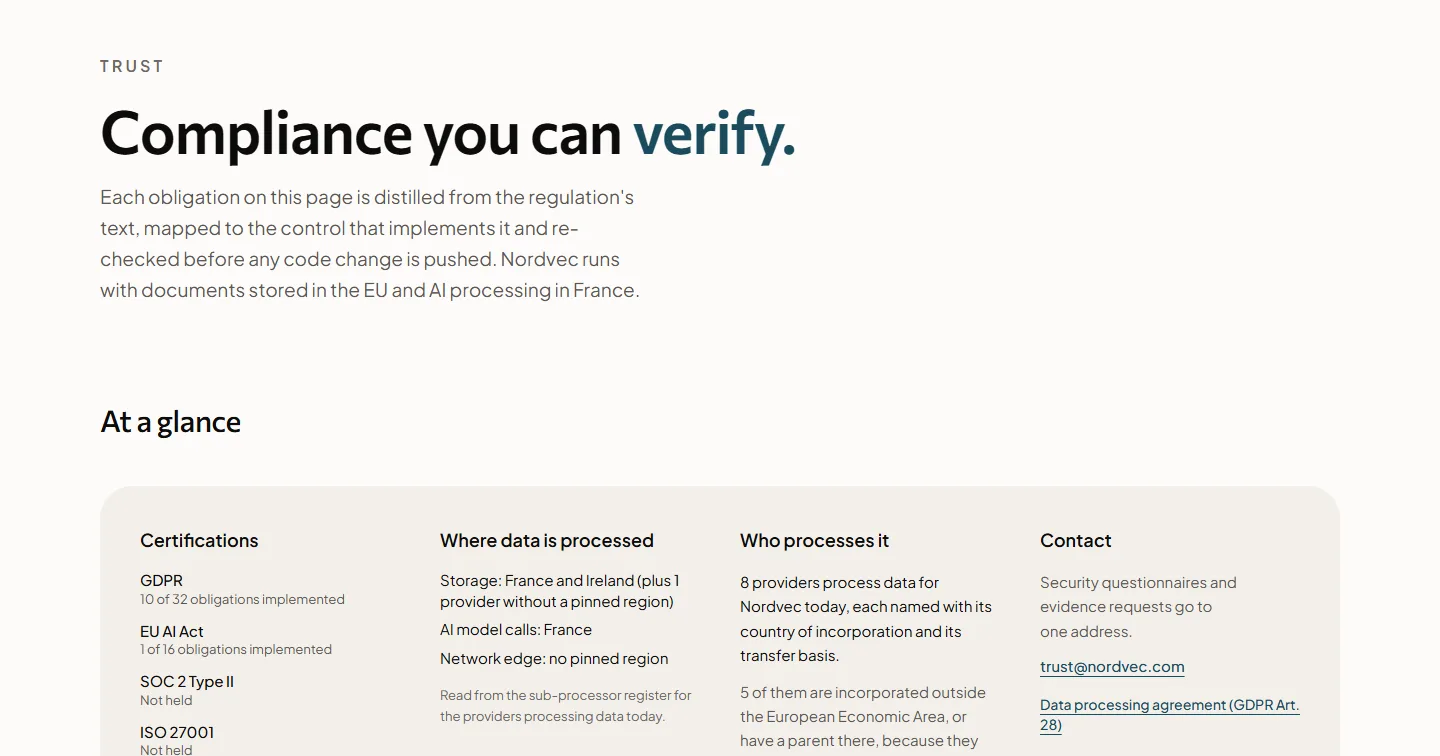
A versioned library of 37 regulations and standards, including GDPR, the AI Act, NIS2, DORA, ISO 27001 and SOC 2, links requirements to the places in the system that meet them and checks them again before any code change is pushed. The trust page shows whether each requirement is met, partly met or open, and links to the sub-processor register.
AI policy generator
A free tool that builds a company AI policy from structured questions. Every section cites the rule or standard behind it, and the policy is built from fixed rules in the browser.
Article 50 checker
A free tool that shows from structured questions which AI Act transparency duties apply, who bears them, and from when.
Why the EU
The big AI tools are American, and US law can give the authorities access to data held by US companies, even when the servers are in Europe. Nordvec's promise is therefore narrow: documents and the search index are stored in the EU, and the language model and text indexing run at Mistral in France.
The promise is EU hosting, because parts of the infrastructure that processes data in the EU still have US owners. Sovereignty is the goal. Three features also reach outside the EU because that is what they are asked to do: web search sends a query the AI writes from the conversation, fetching a web address goes to that address, and webhooks deliver counts and timestamps to the company's own endpoint.
On the way
Planned in Nordvec's roadmap.
Office files in Nordvec
Ordinary Office files should open and be editable directly in Nordvec. Today the AI can rewrite the text of a Word file, and the result is saved as a copy.
Company-wide connections
An administrator connects a source once for the whole workspace, and every answer follows the access rules each person has in the source, such as which folders on a shared drive they may open. More connections are planned too, including the Nordic accounting systems e-conomic, Dinero, Fortnox and Visma.
Ready-made collections
Collections that you switch on with one click and can ask about with citations. The first, Danish legislation, is built, and EU rules and standards follow. Each collection lives in one place and is updated for everyone when a law changes.
Own models and servers in the EU
The language model and indexing are to run on infrastructure Nordvec operates in the EU, with open models, so every link in the chain has European owners.
A local desktop edition
Alongside the sync application, an edition with its own AI model that runs everything locally. It is for those who may not send anything out of the building, such as lawyers, auditors and doctors.
Enterprise
Single sign-on and automatic user provisioning. Nordvec holds neither a SOC 2 report nor an ISO 27001 certificate, and the status of both is on the trust page.
A European office suite
The long-term goal is mail, calendar, chat, documents and spreadsheets as a European alternative to the US suites, which a company can move to one tool at a time.
Open source
partial-content
Nordvec's open source package on npm under the MIT licence: RFC-compliant HTTP file serving from any storage backend, with Range requests (206), conditional caching (304/412), Content-Disposition and ETag generation, plus resumable uploads. Zero dependencies.
Technology
- Framework
- Next.js + React
- Monorepo
- Turborepo + Bun
- Database
- Postgres + pgvector + RLS
- Jobs
- BullMQ + Redis
- AI model
- Mistral (France)
- Desktop
- Electron
The company
Nordvec is developed by Nordvec ApS, a separate company owned by Rasmus K. Damgaard and Mathias B. Andersen, who also own TBH I/S.
Accounts open at launch. Until then, you can join the waitlist at nordvec.com.
Visit nordvec.comNext project
nævn.dk